
Immune Stimulation and Lymphoma Response
Beta LT: FindCure.org has pioneered work (the first site in the US to participate in FDA sanctioned Phase I/II trials) with a potential prescription drug called Beta LT for the treatment of Lymphoma. These trials demonstrated, for the first time, that a non-toxic immune modulator could shrink a very common type of Lymphoma. This work was presented by McGill University and others at the American Society of Hematology. To jump to a copy of this presentation, click here.
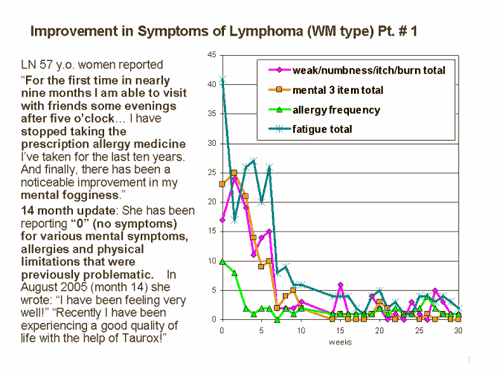
Taurox:FindCure.org has pioneered work on Taurox, an over the counter drug that stimulates the immune system. Taurox does not treat cancer of any type, but people have reported decreased fatigue and in some cases a decrease of other symptoms. Cancer of certain white blood cells is called Lymphoma. The symptoms of some patients with one type of Lymphoma (Waldenstrom's Macroglobulinemia or WM) that causes painful and other sometimes incapacitating symptoms have improved. We know of several patients with this type of lymphoma who have taken Taurox. FindCure.org provided Taurox for their fatigue and other symptoms. Their stories, including the dramatic changes in symptoms and ability to function, are presented below.

Case Reports and Anecdotal information from People with Lymphoma
Beta LT Treatment of Lymphoma and Myeloma
Presented at the American Society of Hematology Conference 2001
Beta-Alethine Phase I/II Data: Immune Stimulation in Patients with Follicular Lymphoma and Myeloma with Evidence of Tumor Response and No Significant Toxicity
Wilson H Miller, Jr. (1), Jean Roy (3), Burt Feldman (4), Andrew Belch (5), Suzin E Mayerson (6), Stephen Caplan (1), Chaim Shustik (2), Denis Claude Roy (3) and Floyd Taub (6). (1)Jewish General Hosp., McGill Univ., Montreal, Quebec, Canada; (2) Royal Victoria Hosp., McGill Univ., Montreal, Canada; (3) Maisonneuve-Rosemont Hosp., Montreal; (4) Victory Over Cancer, Rockville, Maryland, United States; (5) Cross Cancer Institute, Edmonton, Alberta, Canada; and (6) LifeTime Pharmaceuticals, College Park, MD, United States.
Beta-alethine (BA) stimulates T and B-cell functions and has anti-melanoma, myeloma and breast cancer activity in mice. Human PBMCs in culture respond to BA with a coordinated increase in cytokine mRNAs including TNF-alpha, TNF-beta , IFN-gamma and IL-2; lymphocytes become cytotoxic and armed with surface TNF-alpha .
Design: In order to determine safety, efficacy and immune stimulation, 35 pts with low grade B cell lymphoma or myeloma (MM) were administered single agent BA s.c. (2ug) once every 7 or 14 days for up to 18 months at one of 5 sites in Canada or the USA. Pts were evaluated for continuation after 6 injections. Immune system response was evaluated by delayed type hypersensitivity (DTH) to recall antigens and the change in TNF-alpha on the surface of lymphocytes. 15 lymphoma and 17 MM pts are evaluable for safety, 14 lymphoma and 17 MM pts for DTH and tumor responses, and 8 lymphoma and 6 MM pts for TNF effects.
Results: No local or drug related systemic toxicity was observed, although transient neutropenia not clearly related to BA occurred in 3 pts. Surface TNF-alpha was increased from baseline to end of study (p=0.006) among both lymphoma and MM pts. 5/10 pts who were anergic pre-study developed DTH after 3 to 5 doses of BA. 5 lymphoma pts had tumor reductions of 16-64%, assessed as sum of 2D cross products measured by CT scan and/or physical exam. Maximal tumor response included decreases of: 64% (after 6 mo. of BA), 58% (at d64), 53% (12 mo.), 32% (d43) and 16% (d85). All 5 responding pts were DTH+ pre-study. The other 4 DTH+ pts had stable disease after 6 injections. In contrast, 3/5 anergic pts had increased disease, and 2/5 were stable. This relationship of pre-study DTH status and tumor response was significant by a Fisher's Exact test (p=.02). Nine MM pts previously had an autologous stem cell transplant, and 5 others had chemotherapy. One MM pt had a 50% reduction in BJ protein; 3 others had stable disease or small decreases for periods of 9-12 months; 13 had increasing paraprotein.
Discussion: Drug related toxicity was not seen with this low dose and 2 schedules; future studies may use higher doses. Immune stimulation was observed, including DTH response to infectious disease recall antigens and lymphocyte surface TNF-alpha . Although numbers are small, effectiveness in lymphoma appears greater in pts who start the study with more functional immune systems as determined by pre-study DTH testing. All 9 DTH+ lymphoma pts ended the study with decreases in tumor or stable disease. In contrast, pts anergic pre-study had increased tumor (3/5) or stable disease. While other explanations are possible, these data are consistent with BA modulating the immune system of DTH positive pts in a manner allowing reduction of lymphoma. Similarly, the lack of response to BA in heavily pre-treated myeloma pts may reflect the immunosuppressive effects of high-dose chemotherapy. The observed stimulation of immune responses and anti-lymphoma activity seen in the more immunocompetent patients suggests future trials are warranted.
Beta LT was also tested in mice with various cancers. Scientists from UNM reported immune stimulation and dramatic cancer reductions in Cancer Research (1), a prestigious journal.
(1) Knight, G.D., Mann, P.L., Laubscher, K.H., Scallen, T.J. Seemingly Diverse Activities
of B-alethine. Cancer Research 54, 5636-5642 (1994).